

Snus Tracker: Knowing Instead of Guessing
Breezer Team
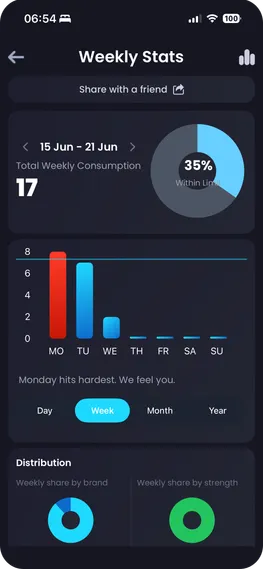
A snus tracker answers one question: how many pouches is it really? Almost nobody can say, because nicotine pouches get used alongside other things rather than at mealtimes, so estimates run low. Breezer logs each one with a tap, and it does not require you to want to quit.
Tracking is not quitting
This is where apps in this space diverge. Most assume you want out: they ask for a quit date, count snus-free days from day one, and treat every pouch as a setback.
For a large share of people that is simply the wrong question. If you only want to know where you stand, you do not need a verdict, you need a number. And if you later decide to cut down or stop, you should not have to change apps to do it.
In Breezer, tracking is the default state. Quit Mode sits alongside it and gets switched on when you are ready. Or never.
What tracking demonstrably does, and what it does not
The honest framing belongs on any page selling an app. The Cochrane review Mobile phone text messaging and app-based interventions for smoking cessation by Robyn Whittaker and colleagues (2019) tested whether phone-delivered programmes raise quit rates.
For smartphone apps the result was a risk ratio of 1.00 (95% CI 0.66–1.52) from 5 studies with 3,079 participants, at very low certainty. That is a draw, not a disproof: the interval leaves everything from clearly worse to clearly better on the table, and the authors explicitly call for more trials.
For automated text message programmes the effect was established: RR 1.54 (1.19–2.00) from 13 studies with 14,133 participants, at moderate certainty. The difference is not the technology. A text message arrives whether or not you open anything. An app waits for you to open it, and that is what fades over the weeks.
For anyone building an app, that is the most useful thing in the whole review: the effective part is whatever reaches you on its own. Limit alerts, milestones, a lock screen widget. Not the hope that someone checks in daily by themselves.
What a tracker still is not: a treatment promise. It is a measuring instrument that gives you the baseline without which no limit and no progress exist. What has the strongest evidence for quitting is on quit snus, and that is counselling.
What becomes visible after two weeks
The gap between your estimate and reality. For most people this is the first jolt, and it is uncomfortable enough to prompt something.
The distribution across the day. The most revealing part, because it exposes triggers without you hunting for them: the first after waking, the one with coffee, the cluster from late afternoon, the weekend jump. Knowing your three triggers means you can take them one at a time.
The link to how you feel. Headaches and nausea are not randomly spread with nicotine pouches. For many people they track closely with the day’s count, and laid side by side your own threshold becomes visible.
The annual figure. The daily price looks harmless; the extrapolation does not. At a can every two days the yearly total reaches four digits in most markets. Breezer calculates from your own pack price and your actual use rather than an average.
The limit is the part that works
Counting alone changes little. What makes the difference is a daily limit you set yourself and see every day.
In Breezer the display turns red once you are over it. The default is ten pouches, and a lot of people set it to five. The level matters less than the fact that the number is yours and stays in view.
Lowering the limit over weeks tends to get people further than halving it in one go. Whether gradual reduction improves long-term quit rates against a clean break has been studied, and the difference is not measurable. On how the quit feels, the research says nothing, and that is exactly where a lower starting point earns its keep.
Features
- One tap per pouch, no menus
- Brand-agnostic, several brands in parallel
- Daily, weekly and monthly breakdowns with charts
- A daily limit with a visible warning
- Cost based on your own pack price
- Lock screen widget for logging without opening the app
- Friends and leaderboards, local and global, if you want them
- Quit Mode for whenever you decide to switch
Free on iOS and Android.
Who this is for
People who want control rather than guilt. The tracker does not judge and does not assume a goal. It is entirely possible that after four weeks you conclude everything is within reason and delete the app. That is a legitimate outcome.
If you want to start by brand, for instance because the strength on the can is unclear, the Zyn tracker page walks through the units. How much nicotine actually reaches your blood is covered in how strong a nicotine pouch really is. And if health is what brought you here, what nicotine pouches do to your gums is an honest account of how thin the evidence still is.
Sources: Whittaker R, McRobbie H, Bullen C, Rodgers A, Gu Y, Dobson R. Mobile phone text messaging and app-based interventions for smoking cessation. Cochrane Database of Systematic Reviews, 2019, CD006611.pub5. — Lindson N, Klemperer E, Hong B, Ordóñez-Mena JM, Aveyard P. Smoking reduction interventions for smoking cessation. Cochrane Database of Systematic Reviews, 2019, CD013183.pub2.
-
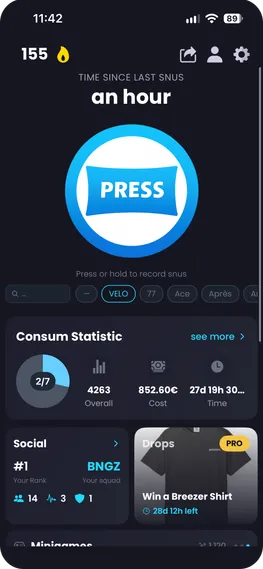
One tap per pouch
-

Compare worldwide
Frequently asked questions
What is a snus tracker?
An app that records every pouch you use and turns it into daily, weekly and monthly figures. The point is not discipline, it is a number: almost nobody knows their real total, because pouches get used in the gaps of a day rather than at fixed times.
Do I have to want to quit to use a tracker?
No, and that is the difference from most apps in this space. Classic quit apps assume you want out, ask for a quit date and count snus-free days from day one. Breezer starts at tracking. Whether that turns into cutting down or quitting is your call, later or never.
Does app-based tracking actually work?
The evidence is open, not negative. The Cochrane review by Whittaker and colleagues (2019) found a risk ratio of 1.00 for smartphone apps at very low certainty: five studies that could not settle the question, not a disproof. For automated prompts arriving from outside the effect is established (RR 1.54), and that is the part notifications and milestones cover.
What will I see after two weeks of tracking?
Three things that were invisible before: your real daily average against your estimate, the times of day where use clusters, and the annual cost. The distribution across the day is usually the most revealing part, because it exposes your triggers without you having to look for them.
Does it work for Zyn and Velo too?
Yes, Breezer is brand-agnostic. Zyn, Velo, LOOP, XQS, Killa, Pablo and traditional snus all land in the same counter. Brand-specific detail, including how to read the strength on the can, is on the Zyn tracker page.
What does Breezer cost?
Tracking is free on iOS and Android, with no subscription for the core features. Pro unlocks additional analysis and achievements.
Try Breezer for free
Download Breezer and start tracking in under a minute.