

Quit Snus: the Withdrawal, Step by Step
Breezer Team
Snus withdrawal starts 4 to 24 hours after your last pouch, peaks at around day three, and tapers off over the following three to four weeks. That part is well documented. What outlasts it is habit, and the thing with the strongest evidence against that is not willpower. It is structured support, which raises quit rates by roughly three quarters.
How long does snus withdrawal last?
The review Nicotine Withdrawal by Ian McLaughlin, John A. Dani and Mariella De Biasi (Current Topics in Behavioral Neurosciences, 2015) puts precise numbers on it: the abstinence syndrome appears 4 to 24 hours after chronic use ends, symptoms peak at approximately the third day, and taper off over the course of the following three to four weeks.
In practice:
- Days 1 to 3: the hardest stretch, with the maximum around day three.
- Days 4 to 14: symptoms fade noticeably, sleep and mood start to settle.
- Weeks 3 to 4: the physical part runs out. What remains is the situations where your hand reaches for a can on autopilot.
Cravings do not disappear on a curve. They get rarer. Knowing that stops you reading a bad day in week four as a return to square one.
Snus withdrawal symptoms: the clinical list
Knowing which complaints belong to withdrawal matters, because otherwise they feel like a personal failing. The same review sets out the seven symptoms the DSM-5 assigns to nicotine withdrawal:
- irritability, anger and frustration
- anxiety
- depressed mood
- difficulty concentrating
- increased appetite
- insomnia
- restlessness
Constipation, dizziness, nightmares, nausea and sore throat can come with it. The authors sort these into three groups: affective (anxiety, low mood, irritability), somatic (tremors, gastrointestinal discomfort, appetite) and cognitive (concentration, memory).
Every one of them is a sign that withdrawal is running, not that something is going wrong.
What actually works, and what does not
This is the section most quitting pages skip, and the findings are not what most people assume. The Cochrane review Interventions for smokeless tobacco use cessation by Jonathan Livingstone-Banks and colleagues (2025) pooled 43 trials with 20,346 participants.
| Intervention | Effect (risk ratio) | Evidence base | Certainty |
|---|---|---|---|
| Behavioural counselling | 1.76 (95% CI 1.44–2.16) | 21 studies, 7,417 people | moderate |
| Varenicline (prescription) | 1.35 (1.08–1.68) | 2 studies, 508 people | moderate |
| Brief advice from a clinician | 1.24 (1.03–1.48) | 7 studies, 6,271 people | moderate |
| Nicotine replacement (patch, gum) | 1.18 (1.05–1.33) | 11 studies, 2,826 people | low |
| Bupropion | 0.89 (0.54–1.44) | 2 studies, 293 people | low, no benefit |
A risk ratio of 1.76 means roughly three quarters more people succeed with counselling than with minimal support. The authors conclude that counselling, brief advice and varenicline each probably help more people quit smokeless tobacco than minimal or no support, and that the low-certainty evidence does not currently support bupropion.
Two caveats belong with that. The review covers smokeless tobacco, meaning traditional snus. Tobacco-free pouches such as Zyn and Velo are newer and do not have this evidence base yet; the behavioural side should carry over, but that is an inference. And varenicline is prescription-only, so it is a conversation with a doctor rather than something you arrange yourself.
How to quit snus: six steps
- Count honestly for two weeks. Almost nobody knows their real number, because pouches get used in gaps rather than at fixed times. Without a baseline you can neither set a limit nor see progress.
- Set a date or a limit. Either a day after which nothing goes in, or a daily cap you lower week by week. Both work, see below.
- Write down your triggers. Coffee, the drive to work, a break with colleagues, the first reach after waking. Three to five concrete situations. General resolutions do not count.
- Get real support. The step with the strongest evidence and the one nearly everyone skips. In the US, Smokefree.gov, run by the National Cancer Institute, offers a free quit plan, a texting programme and live chat with a counsellor, and 1-800-QUIT-NOW connects to free state quitlines. Most countries run an equivalent free service, and the good ones are product-independent rather than cigarette-only.
- Plan the first three days. The peak sits at around day three. Knowing those 72 hours are the worst means not scheduling them into a deadline week.
- Keep measuring past day 14. The physical withdrawal ends in week three or four. The habit does not. That is exactly when most people stop paying attention, and exactly when relapse happens.
Cold turkey or cut down gradually?
For smoking, this has been studied. The Cochrane review Smoking reduction interventions for smoking cessation by Nicola Lindson, Elias Klemperer, Bosun Hong, José M. Ordóñez-Mena and Paul Aveyard (2019) found that reducing before quitting does not improve long-term abstinence. Neither route is superior.
Quit communities split hard on this. One long-term user writes flatly that cutting down does not work and cold turkey is the only way. Another, who had never made it past day two, got clear by dropping the pouches first and staying on gum and mints for a week before dropping nicotine entirely. That second approach is the everyday version of nicotine replacement from the table above, the one with the weakest but real evidence.
Both fit the research once you separate two questions:
- Do more people succeed long term? No measurable difference.
- Does the quit feel more manageable? Different question, and the review does not address it.
From Breezer’s own data we see a pattern on the second question: people who bring their count down with a daily limit first tend to describe Quit Mode as manageable, compared with jumping from full use to zero. That is a product observation rather than a study, but it lines up with what a lower starting point implies.
In Breezer you can run either and switch mid-way: lower a daily limit in the snus tracker first, then turn on Quit Mode when you are ready.
If you pick the cutting-down route, do it on a schedule rather than by intention. The trials that found a benefit used a fixed step-down with a target for every third day, and the people who drifted off that schedule did worse than those who never had one. The 21-day plan for tapering off nicotine pouches sets out the numbers.
Know your number before you lower it
Step one gets skipped most often, and it is the only one that costs nothing. Estimates are almost always too low, because pouches are used in the gaps of a day rather than at set times.
Two things become visible once you actually count.
Where your own limit sits. Headaches and nausea are not random with nicotine pouches. For many people they track closely with the day’s count. Seeing both side by side shows you your own threshold, and it is usually lower than expected.
How often you go over. In Breezer the display turns red once you pass your daily limit. It sounds minor and it is reliably the most useful part of tracking: a number you set yourself and see every day moves consumption more than a resolution without one. The default limit is ten pouches a day, and a lot of people set it to five.
How much nicotine actually reaches you is a separate question, incidentally. The number on the can is the content, not the delivered dose. That is covered in how strong a nicotine pouch really is.
What helps in weak moments
The patterns below recur across quit accounts, for example in the r/QuittingZyn community. These are experience reports, not studies, but they are strikingly consistent and they line up with the timeline above where it counts.
The moment you give yourself permission. One user, three months clear after four failed attempts, calls it the “event”: the argument, the bad day at work, the night out. That is when your head flips to “I’ve earned this” or “I’ll quit next week.” His conclusion: those moments never stop coming, so waiting for a calm stretch is not a plan. Get through one and the next is easier.
Write the reasons down, where you will see them. Another pinned a note to his phone listing why he wanted to quit, so it was the first thing he saw on unlocking. It sounds trivial, and it targets precisely the moment above, when the justification gets invented.
Physically over is not over. A day-six account puts it exactly: the physical symptoms were gone by day four, the cravings were not, and day two was the worst. That maps almost precisely onto the research timeline, and it explains the most common relapse: your body signals all clear, the habit does not.
Relapse is the norm, not the end. Among these accounts, one had three or four failed attempts before the one that stuck, and another relapsed after a successful quit and did it again. Most attempts fail in weeks two and three, right when the physical part fades.
“But it keeps me calm” is the objection worth checking. Across 102 studies and over 169,500 people, anxiety and stress went down after quitting, not up. Why the pouch still feels like relief anyway is in nicotine pouches and stress.
And the old advice that still holds: an acute craving lasts a few minutes. It just does not feel that way.
Why your environment matters more than willpower
The evidence here is unusually clear, and it explains why quitting alone at the kitchen table so rarely sticks. The Cochrane review Group behaviour therapy programmes for smoking cessation by Lindsay F. Stead, Allison J. Carroll and Tim Lancaster (2017) pooled 66 trials:
| Comparison | Effect | Evidence base |
|---|---|---|
| Group instead of self-help material | RR 1.88 (1.52–2.33) | 13 studies, 4,395 people |
| Group instead of no help at all | RR 2.60 (1.80–3.76) | 9 studies, 1,098 people |
| Group instead of brief clinician support | RR 1.22 (1.03–1.43) | 14 studies, 7,286 people |
| Group instead of equally intensive one-to-one counselling | RR 0.99 (0.76–1.28) | 6 studies, 980 people |
The authors put it in plain numbers: if 5 in 100 people stay off for six months using self-help materials, 8 to 12 in 100 manage it with group support.
The last row is the one usually left out, and it is the important one: against one-to-one counselling of the same intensity, the group does not win. So it is not the group as such. It is committed, regular support. The group is simply how most people ever get access to any.
Two practical consequences. Quitting alongside someone else is not a nice extra, it is the part that moves the needle. And the distinction that matters is people pursuing the same goal, not merely telling people. The quit accounts show that as an apparent contradiction: one advises avoiding your Zyn-using friend for the first week, another was fine around users. Both describe the same rule from opposite sides. What counts is whether your environment pulls with you or against you.
Why Breezer is built this way
That is what the decision to build Breezer social rather than single-player rests on. Two things are established in this literature, and an app can do both:
- People pursuing the same goal (group programmes, RR 1.88). In Breezer that is friends, leaderboards and a shared progress view.
- Prompts that arrive from outside rather than waiting for someone to open the app (automated messaging, RR 1.54 in the Cochrane review by Whittaker and colleagues, 2019). In Breezer that is milestones, limit alerts and notifications.
This is explicitly not a claim that Breezer has a demonstrated success rate. For apps as such the evidence is open. It is the reasoning behind why the product looks the way it does: the social layer is not an add-on, it is an attempt to make what actually works in the research available without a referral or a waiting list.
What 821 quit attempts look like from the inside
Breezer stores a quit attempt as a start date that keeps running until someone ends it. On 16 September 2026 the app held 821 attempts, and 391 of them were still running. Among the attempts that were at least ninety days old, 224 of 535 were still running.
One caveat decides what those figures are worth. An attempt counts as finished only when somebody ends it in the app. Anyone who simply stops opening Breezer stays counted as running, so 391 is an upper bound on how many people are still off snus, not a success rate. Published quit rates come from trials that follow people up and ask them; an app nobody opens cannot ask.
What the figures do show is how the attempt is carried, and that is the part with evidence behind it: automated prompts that arrive from outside reached RR 1.54 in the Cochrane review of mobile phone-based interventions by Robert Whittaker and colleagues (2019), while apps people have to open themselves came out at RR 1.00. Three things do the carrying.
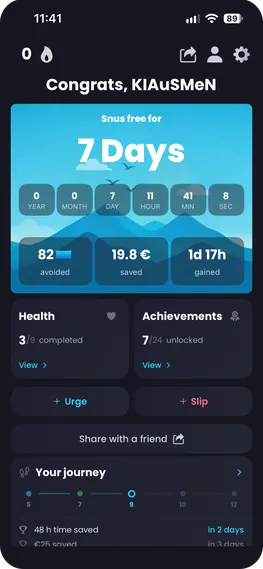
The journey. Every day of the attempt holds three entries: the withdrawal symptom easing, the health improvement due next, and what has been saved by then. A day on the path shows what changed, which a counter alone does not.
The craving, logged while it lasts. An acute craving passes in minutes, but it never feels that way from inside one. Writing it down while it happens turns it into an entry with a start and an end, and the count of them falling week by week is the evidence that it is getting easier.
A slip is an entry, not an ending. Logging a slip leaves the attempt running. Relapse is the norm rather than the end, and the quit accounts above say the same: several needed three or four attempts before one held.
Quitting with Breezer
Breezer has a dedicated Quit Mode that makes visible what you otherwise cannot feel: log withdrawal symptoms daily and watch the intensity curve, see savings in money and in pouches skipped based on your actual previous use, keep streaks for every snus-free day, a lock screen widget, and friends following your quit if you want them to.
The app also shows health milestones from day 1 to year 5:
| Point | What the app shows | Plan |
|---|---|---|
| Day 1 | Heart rate and pulse settle | free |
| Day 3 | Taste and smell return | free |
| Day 7 | Mouth feels fresher, gums less irritated, less dryness | free |
| Day 14 | Better circulation, more energy, small wounds heal faster | free |
| Day 30 | Your body no longer needs the nicotine physically | Pro |
| Day 90 | Skin looks healthier, gums recover | Pro |
The first four are in the free version, the later ones are part of Breezer Pro, along with the rest of the quitting journey. What is free and what Pro adds lists the split in full.
These milestones are orientation points adapted from tobacco cessation. For nicotine pouches specifically, recovery in the mouth is barely researched: the systematic review by Rungraungrayabkul and colleagues (BMC Oral Health, 2024) found only three studies with 190 participants in total and states explicitly that whether mucosal changes fully reverse after stopping is not established. What that means for your gums is covered in what nicotine pouches do to your gums.
The difference from pure quit apps: Breezer also knows the road in. You can track, cut down, and only then quit, instead of choosing between two apps. It does not replace counselling, and on the evidence above counselling is the intervention with the strongest support.
Works for every nicotine pouch
Zyn, Velo, or traditional snus: Quit Mode works for all nicotine pouches. If you only want to see how much it actually is first, start on the Zyn tracker page.
If your use is tied to training, nicotine pouches and sport is worth reading before you quit: disrupted sleep is the effect with the clearest downside for anyone training seriously, and it appears both during use and during withdrawal.
Sources: McLaughlin I, Dani JA, De Biasi M. Nicotine Withdrawal. Current Topics in Behavioral Neurosciences, 2015. — Livingstone-Banks J, Vidyasagaran AL, Croucher R et al. Interventions for smokeless tobacco use cessation. Cochrane Database of Systematic Reviews, 2025, CD015314.pub2. — Stead LF, Carroll AJ, Lancaster T. Group behaviour therapy programmes for smoking cessation. Cochrane Database of Systematic Reviews, 2017, Issue 3, CD001007.pub3. — Lindson N, Klemperer E, Hong B, Ordóñez-Mena JM, Aveyard P. Smoking reduction interventions for smoking cessation. Cochrane Database of Systematic Reviews, 2019, CD013183.pub2. — Rungraungrayabkul D, Gaewkhiew P, Vichayanrat T, Shrestha B, Buajeeb W. What is the impact of nicotine pouches on oral health: a systematic review. BMC Oral Health, 2024;24:889.
The quoted experience reports come from the r/QuittingZyn community. They are labelled as experience and do not substitute for research. This article is not medical advice; for severe or persistent symptoms, see a doctor.
-
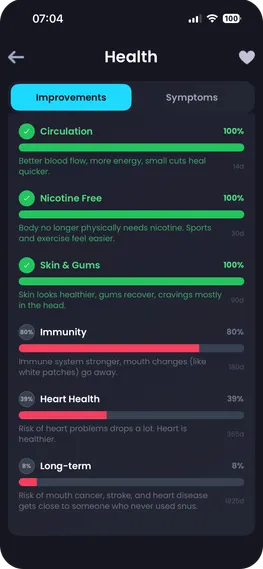
Health milestones
-
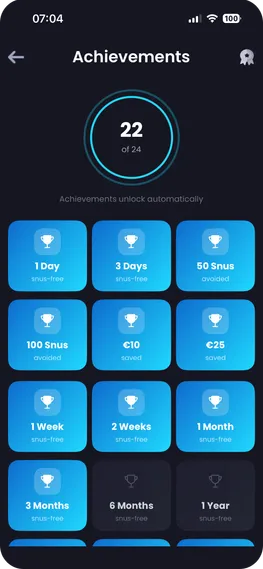
Streaks and achievements
Frequently asked questions
How long does snus withdrawal last?
Symptoms appear 4 to 24 hours after your last pouch, peak at around day three, and taper off over the following three to four weeks. That is the timeline described in the review by McLaughlin, Dani and De Biasi (2015). Cravings can still surface after that, but they get shorter and less frequent.
What are the symptoms of snus withdrawal?
The DSM-5 lists seven: irritability, anger and frustration; anxiety; depressed mood; difficulty concentrating; increased appetite; insomnia; and restlessness. Constipation, dizziness, nightmares, nausea and sore throat can also occur. All of them are signs that withdrawal is running its course, not that something is going wrong.
What actually helps you quit snus?
A 2025 Cochrane review covering 43 trials and 20,346 participants found behavioural counselling the strongest option, with a risk ratio of 1.76 against minimal support. Varenicline and brief advice from a clinician also helped. The review found no benefit from bupropion.
Should I quit snus cold turkey or cut down gradually?
For smoking, the Cochrane review by Lindson and colleagues (2019) found that cutting down before quitting does not improve long-term abstinence. Neither approach wins, so pick the one that fits your use. Heavy long-term users often get further with a daily limit they lower week by week; light users have less to negotiate with a clean stop.
How many days is the hardest part of quitting snus?
Day two and day three. The peak sits at roughly day three, and users in quit communities consistently describe the physical side easing off around day four while cravings continue. Most failed attempts happen in weeks two and three, right when the physical withdrawal fades and only the habit is left.
What happens to your body after you quit snus?
The withdrawal timeline is well described: peak around day three, substantial improvement over three to four weeks. Recovery in the mouth is far less certain. The systematic review by Rungraungrayabkul and colleagues (2024) states explicitly that whether mucosal changes fully reverse after stopping has not been established.
How many people are quitting snus with Breezer?
On 16 September 2026 the app held 821 quit attempts, 391 of them still running. An attempt is only marked finished when somebody ends it in the app, so that figure is an upper bound rather than a success rate: anyone who stops opening the app stays counted as running.
Does one slip end a quit attempt?
Not in Breezer. A slip is logged as an entry and the attempt keeps running. That matches how quitting actually goes: among the quit accounts quoted in this guide, several people needed three or four attempts before one held, and most failed attempts break in weeks two and three, when the physical symptoms have already faded.
How much money do you save by quitting snus?
It depends on your previous use. At a can every two days it adds up to several hundred a year, and at a can a day it runs well into four figures. Breezer calculates the saving from your quit date using what you actually used before and your own pack price, rather than an average.
Try Breezer for free
Download Breezer and start tracking in under a minute.