

What Nicotine Pouches Do to Your Gums
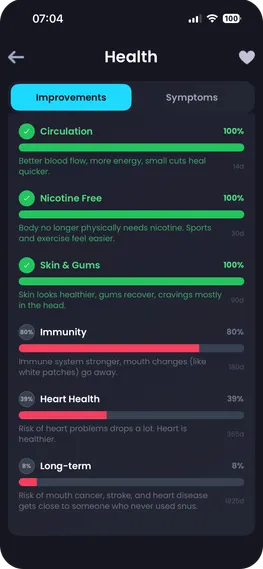
If you have noticed a pale, slightly wrinkled patch where you park your pouch, that is the most consistently documented effect in the research: local changes to the tissue at the placement site. What is far less certain is what those changes mean over years, because almost nobody has studied it yet.
This is one of those topics where the internet gives you two confident answers, both wrong. Here is the actual state of the evidence.
What the research has established
The most useful summary is a systematic review published in BMC Oral Health in August 2024, which pooled everything available at the time.
What it found in pouch users:
- Mucosal changes at the placement site, described as ranging from slight wrinkling of the tissue to distinct white lesions.
- Severity correlated with duration of use and daily unit consumption. More pouches, longer contact, more visible change.
- Elevated salivary inflammatory biomarkers (IL-6, IL-8, IL-1β, TNF-α) in one of the included studies.
- Dry mouth, gingival blisters and soreness as additional reported effects.
The authors’ conclusion, verbatim:
“Although studies on the impact of NP on oral health status are scarce, available evidence showed that NP could affect oral mucosa and gingival status.”
Note the wording. Not “causes damage”. Could affect. That is deliberate, and the next section explains why.
The evidence base is thinner than almost anyone admits
This is the part that gets left out of both the alarming articles and the reassuring ones. The review identified only three eligible studies, covering 190 participants in total, from the USA, Sweden and Latvia, published between 2022 and 2024. Two were cross-sectional, one was a prospective experimental study.
The authors rated all three as having a high risk of bias, with inadequate sample sizes, and flagged that the studies could not reliably separate tobacco-containing snus from tobacco-free nicotine pouches. Their explicit call was for well-designed studies with larger cohorts and standardised outcome measurement.
Three small, biased studies is not a foundation for a confident claim in either direction. Be suspicious of any page, including the ones selling pouches and the ones selling fear, that sounds more certain than that.
What is genuinely not known
- Cancer risk. The elevated inflammatory markers are a reason to investigate, not a demonstrated link. Nobody has the decades of outcome data that would settle it.
- Whether changes reverse. Whether a lesion at the placement site fully resolves after stopping, and over what timeframe, has not been properly measured.
- Gum recession specifically. You will find precise-sounding percentages online. Most trace back to commercial sites rather than to published research, so treat them accordingly.
- Cardiovascular effects. Outside the mouth, the long-term picture for pouches specifically is largely open.
What actually reduces the load
The one relationship the research does support is a dose relationship: severity tracked with how much and how long. That points at the practical measures.
- Do not always use the same spot. Constant contact in one place is what produces the localised change. Rotating sides spreads it.
- Do not leave a pouch in longer than you need. Most of the nicotine is delivered in the first stretch; the remaining time is contact without much benefit.
- Drink water. Dry mouth is one of the most commonly reported effects, and saliva is what protects the tissue.
- Get a patch checked if it persists. A white area that does not resolve within about two weeks after you stop is a dentist visit, not a forum question. This article is not medical advice and cannot substitute for one.
- Lower the daily count. This is the one with the most evidence behind it, and the one almost nobody measures.
The number you can actually control
You cannot change how a pouch interacts with your gums. You can change how many hours a day there is one in your mouth, and that is the variable the research keeps pointing at.
The mouth is one effect among several, and they do not all rest on the same quality of evidence. Nicotine pouch side effects, ranked by the evidence sorts each one by what actually establishes it.
Most people underestimate their own count substantially, because pouches get used in gaps, not at mealtimes. Breezer logs each one with a single tap and shows the weekly pattern, so the figure stops being a guess. From there you can set a daily limit in the snus tracker, or move to Quit Mode if you would rather bring it to zero.
If the goal is simply less contact per day, it also helps to know that the strength on the can is often not the dose you think it is. That is covered in how strong a nicotine pouch really is. Brand-specific logging lives on the Zyn tracker page.
Source: Rungraungrayabkul D, Gaewkhiew P, Vichayanrat T, Shrestha B, Buajeeb W. What is the impact of nicotine pouches on oral health: a systematic review. BMC Oral Health. 2024 Aug 3;24:889.
Frequently asked questions
Do nicotine pouches damage your gums?
They visibly affect the tissue where you place them. The available research documents mucosal changes at the placement site, ranging from slight wrinkling to white lesions, with severity linked to how long and how much someone uses. Whether that leads to lasting damage is not yet established.
What are the white patches from nicotine pouches?
They are mucosal lesions at the spot where the pouch sits, caused by prolonged local contact. Studies describe them as ranging from mild wrinkling of the tissue to distinct white patches. If a patch does not disappear within two weeks of stopping, a dentist should look at it.
Do nicotine pouches cause oral cancer?
There is not enough evidence to say. One study found elevated inflammatory markers in the saliva of pouch users, which is a reason to keep researching rather than a demonstrated cancer link. The products are too new for long-term outcome data to exist.
How much research exists on nicotine pouches and oral health?
Very little. The 2024 systematic review in BMC Oral Health found only three eligible studies covering 190 participants in total, and rated all three as having a high risk of bias. That is a genuinely thin evidence base.
How can I reduce the effect on my gums?
The two things clearly linked to severity are how long you keep a pouch in and how many you use per day. Rotating the placement spot rather than always using the same one, and staying hydrated against dry mouth, are the practical measures. Reducing the daily count is the one with the most evidence behind it.
Try Breezer for free
Download Breezer and start tracking in under a minute.