

What Nicotine Pouches Actually Do to You
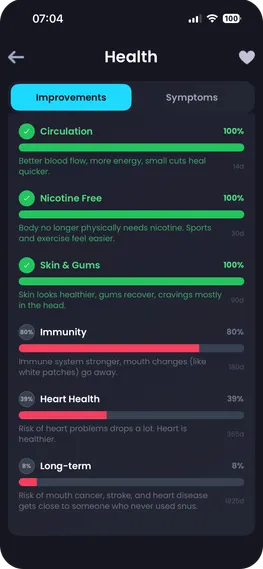
The honest summary is short. In randomised trials the reported effects were mild, dose-dependent and limited to cough, throat irritation and headache, with no serious adverse events. But the entire randomised evidence base for nicotine pouches is a few hundred people over a few weeks, so “no serious harms found” mostly means nobody has looked for long enough.
How to read this page
Every list of nicotine pouch side effects on the internet mixes three very different things and presents them as one. This page keeps them apart, because the difference is the whole information.
- Trial evidence. Measured under randomised or controlled conditions. Small samples, but the effect was observed rather than reported.
- Observational evidence. Found by examining users, without a control condition. Real, but confounded and usually at high risk of bias.
- Self-report only. People say it happens. That is a lead, not a finding, and surveys of this kind cannot establish that the pouches caused it.
A fourth category matters too: not established, which covers the things people worry about most.
Every effect, and what actually shows it
| Effect | What shows it | Tier |
|---|---|---|
| Cough, throat irritation | 7 randomised trials, dose-dependent | Trial evidence |
| Headache | Same review | Trial evidence |
| Mouth irritation at higher strengths | Controlled crossover, 15 participants | Trial evidence |
| Heart-rate rise (~25 bpm at 30 mg) | Same crossover | Trial evidence |
| Mucosal changes at the placement site | Systematic review, 3 studies, 190 people, all high risk of bias | Weak observational |
| Nausea, reflux | Cross-sectional survey only | Self-report only |
| Sleep disruption | Nicotine research, not pouch research | Indirect |
| Gum recession, tooth loss | Nothing establishes it | Not established |
| Oral cancer | Nothing establishes it; products too new | Not established |
| Dependence | Trial authors and health authorities agree | Strong |
What the randomised trials found, and how small they are
Two systematic reviews published in 2025 cover essentially all of it.
Nicotine pouches and clinical outcomes related to smoking cessation, by Javad Heshmati, Sara Shahen, Emily Bates and colleagues in Addiction, pooled seven randomised trials with 269 adult participants. Adverse events were mostly mild — cough, throat irritation, headache — and occurred more frequently at higher nicotine doses. No serious adverse events were reported.
The Cochrane review Oral nicotine pouches for cessation or reduction of use of other tobacco or nicotine products (24 October 2025) covers four trials with 284 participants, three at high risk of bias and one industry-funded. No serious adverse events occurred in the three studies that reported them.
Put those side by side and the picture is clear. A few hundred people, followed for weeks, in trials designed to study quitting rather than harm. Nicotine pouches reached the global market in 2016. Nobody has watched anyone use them for a decade, because a decade has barely passed.
The mouth: the most documented effect, on the thinnest evidence
The tissue where the pouch sits changes. That is the single most consistent finding in the literature, and it is still built on very little.
The systematic review by Duangjai Rungraungrayabkul and colleagues in BMC Oral Health (August 2024) found only three eligible studies covering 190 participants, and rated all three as having a high risk of bias. What they describe ranges from slight wrinkling of the mucosa to distinct white patches, with severity linked to how long a pouch stays in and how many are used per day.
What is not established: whether those changes reverse after stopping, and whether they lead anywhere over years. The full picture, including what users consistently report and what nobody can answer yet, is in what nicotine pouches do to your gums.
A practical rule falls out of the dose-severity link: if a white patch does not disappear within two weeks of stopping, a dentist should look at it.
Heart rate and blood vessels
This is where the strength on the can stops being a detail.
In a crossover trial at LMU Munich published in Frontiers in Pharmacology on 22 May 2024, Nadja Mallock-Ohnesorg, Andrea Rabenstein and colleagues tested 6 mg, 20 mg and 30 mg pouches against a cigarette in 15 smokers.
The 30 mg pouch produced:
- a heart-rate rise of about 25 beats per minute, matching the cigarette
- elevated arterial stiffness measures
- strong mouth irritation
- a peak blood nicotine of 29.4 ng/mL, against 15.2 ng/mL for the cigarette
The 6 mg pouch produced 2.8 ng/mL and none of the strong effects. Same product category, roughly a tenfold difference in dose, which is why “nicotine pouch side effects” is not one question. How to read the number on the can is covered in how strong a nicotine pouch really is.
What people report that no trial has confirmed
A cross-sectional survey by E. M. Elsokkary and colleagues in Tobacco Induced Diseases (2025) asked 385 pouch users in Riyadh province what they experienced. Mouth or gum irritation and nausea were each reported by 42 percent, reflux by 35.4 percent, and a raised heart rate by 25.3 percent. About a third reported no symptoms at all.
The authors list the limitations themselves, and they are the important part: the design cannot establish causality, the data are self-reported with recall and social-desirability bias, there were no adjusted comparisons, and recruiting online and in tobacco shops selects for people with strong opinions.
So this is the tier that tells you what to watch for in yourself, and nothing about what pouches cause. Both halves of that sentence matter.
The one area with hard numbers
The best-quantified harm in this whole category is not a side effect in users at all.
A study led by Gary Smith and Hannah Hays at Nationwide Children’s Hospital and the Central Ohio Poison Center, published in Pediatrics on 14 July 2025, examined nearly 135,000 nicotine ingestions by children under six reported to US poison centres between 2010 and 2023.
The rate of nicotine pouch ingestions rose 763 percent between 2020 and 2023. Across all nicotine products in the dataset there were 39 cases with major medical outcomes and two deaths, and pouches were more likely than gum, lozenges, e-liquids, powders or tablets to be linked to a serious medical outcome or a hospital admission.
The mitigation is unglamorous and effective: a tin out of reach is not the same as a tin on the coffee table, and pouches look like sweets to a two-year-old.
The effect with the strongest evidence and the least attention
Dependence. It is not on most side-effect lists because it is not experienced as a symptom, and it is the one thing nearly everyone agrees on.
The Munich researchers concluded that pouches containing 30 mg of nicotine “may induce addiction” and questioned whether such doses are necessary at all. Austria’s health ministry lists a high dependence potential among its reasons for bringing pouches into tobacco law in 2026.
The reason it goes unnoticed is structural. Pouches are used in the gaps of a day rather than in breaks that interrupt something, so the daily count climbs without a moment that registers as a decision.
What actually lowers the load
Three variables track with severity across almost everything above: how strong, how long it sits, how many per day.
The first two are single choices. The third is the one that drifts, and it is the only one you cannot estimate accurately — recalled counts run low, reliably, because the pouches nobody notices are the ones nobody counts.
Breezer logs each pouch with one tap and turns that into a daily and weekly total against a limit you set yourself. Start with the snus tracker, or the Zyn tracker for a single brand. If the number is higher than you expected, the 21-day step-down plan brings it down on a schedule, and Quit Mode takes over from a fixed quit date.
Four related pages: nicotine pouches and sleep, which is the effect most people notice first and attribute to something else, nicotine pouches and stress for the one that is usually counted as a benefit rather than an effect, nicotine pouches and sport if your use sits around training, and nicotine pouches, erections and fertility for the question people search anonymously and never ask out loud.
Sources: Heshmati J, Shahen S, Bates EL, Visintini S, Quirouette E, Mullen KA, Mir H. Nicotine pouches and clinical outcomes related to smoking cessation: A systematic review of randomized trials. Addiction, 2025. — Hartmann-Boyce J, Tattan-Birch H, Brown J et al. Oral nicotine pouches for cessation or reduction of use of other tobacco or nicotine products. Cochrane Database of Systematic Reviews, 2025, Issue 10, CD016220.pub2. — Rungraungrayabkul D, Gaewkhiew P, Vichayanrat T, Shrestha B, Buajeeb W. What is the impact of nicotine pouches on oral health: a systematic review. BMC Oral Health, 2024;24:889. — Mallock-Ohnesorg N, Rabenstein A, Stoll Y et al. Small pouches, but high nicotine doses. Frontiers in Pharmacology, 22 May 2024. — Elsokkary EM, Alsabhan FA, Alyahya AA et al. Exploring the effect of nicotine pouches on users’ health in Saudi Arabia: A cross-sectional study. Tobacco Induced Diseases, 2025. — Smith GA, Hays H et al. Nicotine Ingestions Among Young Children, 2010–2023. Pediatrics, 14 July 2025. — Federal Ministry of Social Affairs, Health, Care and Consumer Protection (Austria), Tabakfreie Nikotinerzeugnisse, retrieved September 2026.
This article is not medical advice. A patch that does not clear, chest symptoms, or a suspected ingestion by a child belong with a doctor or a poison centre, not with a website.
Frequently asked questions
What are the side effects of nicotine pouches?
In randomised trials the reported effects were mild and dose-dependent: cough, throat irritation and headache, with no serious adverse events. A controlled crossover study additionally measured a heart-rate rise of about 25 beats per minute from a 30 mg pouch. Mucosal changes where the pouch sits are documented, though on a thin evidence base.
How much research exists on nicotine pouch side effects?
Very little. The systematic review in Addiction covers seven randomised trials with 269 participants in total, and the Cochrane review of pouches for smoking cessation covers four trials with 284. Both are small, short and mostly at high risk of bias. That is the entire randomised evidence base.
Are the side effects worse with stronger pouches?
Yes, and that is one of the more consistent findings. The Addiction review reports adverse events occurring more frequently at higher nicotine doses. The Munich crossover study found strong mouth irritation and a 25 bpm heart-rate rise specifically at 30 mg, not at 6 mg.
Do nicotine pouches cause serious harm?
No serious adverse events were reported in any of the randomised trials so far. That is genuinely reassuring about short-term use and says nothing about years of use, because no trial has run that long. The products reached the global market in 2016.
Are nicotine pouches dangerous for children?
This is the one area with hard numbers. A study in Pediatrics using US poison centre data found the rate of nicotine pouch ingestions by children under six rose 763 percent between 2020 and 2023, and that pouches were more likely than other nicotine formulations to be linked to serious medical outcomes or hospital admission.
What reduces the side effects of nicotine pouches?
The two factors that consistently track with severity are dose and exposure: how strong the pouch is, how long it stays in, and how many you use per day. Rotating the placement spot and staying hydrated against dry mouth are the practical measures. Lowering the daily count is the one with the most behind it.
Try Breezer for free
Download Breezer and start tracking in under a minute.