

Cutting Down on Nicotine Pouches, Day by Day
Cutting down works about as well as stopping outright, and only if you follow a fixed schedule. A Cochrane review comparing the two found identical quit rates. What changed the outcome in trials was structure: a step-down with a defined target for every three days beat usual care by 35 percent to 22 percent. The people who drifted off the schedule did worse than the people who never started one.
Does cutting down actually work?
Not on its own, and the numbers here are unusually clear.
The Cochrane review Smoking reduction interventions for smoking cessation by Nicola Lindson, Elias Klemperer, Bosun Hong, José M. Ordóñez-Mena and Paul Aveyard, published in September 2019, pooled 51 trials with 22,509 participants. The direct comparison of reduction-to-quit against abrupt quitting covered 22 studies and 9,219 people.
Risk ratio 1.01 (95% CI 0.87 to 1.17), moderate-certainty evidence. A tie, with a confidence interval too narrow to hide a meaningful difference.
One thing did move the result. Reduction supported by fast-acting nicotine replacement or varenicline produced risk ratio 1.68 (95% CI 1.09 to 2.58) against reduction without it, also moderate certainty.
So the honest framing is not “tapering is the gentler route that works better”. It is: tapering is one of two equally good routes, and it stops being equally good the moment it is unstructured.
Nobody has trialled tapering nicotine pouches
This needs saying before any schedule, because every plan on this page is transferred from smoking research.
Cochrane published the first systematic review of nicotine pouches for cessation and reduction on 24 October 2025: Oral nicotine pouches for cessation or reduction of use of other tobacco or nicotine products, by Jamie Hartmann-Boyce and colleagues. It found four small trials with 284 participants in total, all of them in people who smoked cigarettes.
Its conclusion on the question at hand is one sentence: “There is no evidence on the use of ONP for cessation or reduction of other tobacco or nicotine products.”
That means no trial has ever tested a step-down plan for pouches. Not one. The schedule below is an adaptation, and it is offered as an adaptation rather than as evidence about pouches, because pretending otherwise would be the kind of claim this whole category is already full of.
The 21-day schedule, and where it comes from
The protocol comes from a randomised trial by Paul M. Cinciripini and colleagues, published in JMIR Formative Research in 2023, which randomised 916 people and analysed 820.
Its computerised step-down worked like this:
- Days 1 to 12: reduce the baseline count by 15 percent every three days.
- Days 13 to 21: reduce by a further 10 percent of baseline every three days.
- Every week: push the first one of the day 15 minutes later than the week before.
- Day 22: the quit date, fixed in advance.
The trial reported roughly a 75 percent reduction by week three, with a final-week target of three to four cigarettes a day.
Translated to pouches, at three common starting counts:
| Days | Cut from baseline | From 8/day | From 12/day | From 20/day |
|---|---|---|---|---|
| 1–3 | 15% | 7 | 10 | 17 |
| 4–6 | 30% | 6 | 8 | 14 |
| 7–9 | 45% | 4 | 7 | 11 |
| 10–12 | 60% | 3 | 5 | 8 |
| 13–15 | 70% | 2 | 4 | 6 |
| 16–18 | 80% | 2 | 2 | 4 |
| 19–21 | 90% | 1 | 2 | 2 |
| 22 | quit day | 0 | 0 | 0 |
The baseline is not your estimate. It is a count from an ordinary week before you change anything, which is the step almost everyone skips.
Count or strength: which number do you lower?
A cigarette is roughly a fixed dose. A pouch is not, and that gives a taper two levers instead of one.
The spread is larger than most people expect. In a crossover trial at LMU Munich published in Frontiers in Pharmacology in May 2024, Nadja Mallock-Ohnesorg, Andrea Rabenstein and colleagues measured peak blood nicotine across pouch strengths in 15 smokers:
- 6 mg pouch: 2.8 ng/mL
- 20 mg pouch: 7.1 ng/mL
- 30 mg pouch: 29.4 ng/mL
- A cigarette, for comparison: 15.2 ng/mL
A tenfold difference between the weakest and the strongest, and the strongest is roughly double a cigarette. Which means “I cut down to five a day” says very little unless the can stayed the same.
Lower the count, and keep the strength fixed for the three weeks. Two moving numbers cannot be read against each other, and the count is the one you can verify at the end of a day. If you want to step the strength down as well, do it after the count is stable, not during. How the number on the can relates to the dose you actually get is covered in how strong a nicotine pouch really is.
Taper or clean break: which fits you
| Scheduled taper | Cold turkey | |
|---|---|---|
| Long-term quit rate | Same | Same |
| Withdrawal | Spread over three weeks | Concentrated, peaks around day three |
| Needs a daily count | Yes, it is the whole method | No |
| Main failure mode | Drifting off the schedule | Days two and three |
| Suits | Heavy, long-term use | Light or irregular use |
| Evidence base | Smoking trials, not pouch trials | Smoking trials, not pouch trials |
The withdrawal side of a clean break, symptom by symptom and day by day, is on the quit snus page.
What actually goes wrong
The schedule gets renegotiated. This is the finding worth carrying out of the Cinciripini trial. Among people who complied with the step-down and used a pre-quit nicotine patch, abstinence was 35 percent at four weeks against 22 percent for usual care. Among people who did not comply, outcomes were worse than the control group’s. A schedule you argue with is not a weaker version of a schedule; it is worse than not having one.
The baseline is guessed. Pouches get used in the gaps of a day rather than at set times, so recalled counts run low. A taper built on a number that is 20 percent too low starts you at a target you were already near, and the first week does nothing.
The strength quietly rises. Fewer pouches, stronger can, same nicotine. Nobody has trialled this specific compensation in pouch users, so treat it as a thing to watch rather than a fact, but the arithmetic above makes it easy to do by accident.
Day 22 has no plan. The taper ends and nothing replaces it. The step with the strongest evidence behind it in this entire field is the one people skip: counselling.
What to do about day 22 before you get there
The Cochrane review Interventions for smokeless tobacco use cessation, published on 15 April 2025 by Jonathan Livingstone-Banks and colleagues, covers 43 studies and 20,346 participants.
Behavioural counselling: 23 to 34 people in 100 stop, against 16 in 100 with minimal or no support. Varenicline and brief advice from a clinician also helped; the review found the effect of bupropion uncertain.
In Austria that is free. The Rauchfrei Telefon on 0800 810 013 is anonymous, staffed by clinical psychologists, and explicitly product-independent, so nicotine pouches are covered.
Book it for week two of the taper, not for day 22. By week two you have real numbers to bring, and the appointment exists before the day you will most want to skip it.
The part an app is actually for
A step-down plan is arithmetic plus a memory. Neither is what a person is good at on day 14.
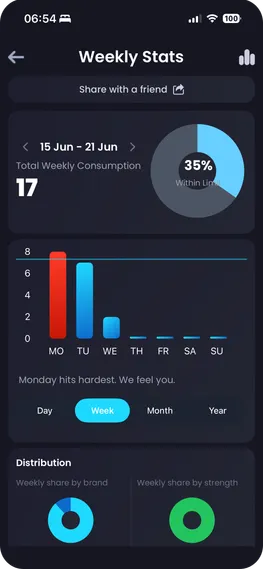
Breezer logs each pouch with one tap and shows the day against the limit you set, which is where a taper either holds or quietly stops. The daily limit is the field that does the work: set it to the row you are on, lower it every three days, and the display turns red when you pass it. Start with the snus tracker, or the Zyn tracker if you use one brand throughout. When day 22 arrives, Quit Mode picks up with the withdrawal timeline and a savings count that uses your real baseline rather than an average.
The one week that matters most is the one before day 1, when you are still counting normally and changing nothing.
If you came to pouches from cigarettes and are now trying to get off both, what the evidence says about nicotine pouches for quitting smoking covers what that switch is and is not supported by. And if it is the oral-health side driving the decision, what nicotine pouches do to your gums goes through the research.
Sources: Lindson N, Klemperer E, Hong B, Ordóñez-Mena JM, Aveyard P. Smoking reduction interventions for smoking cessation. Cochrane Database of Systematic Reviews, 2019, CD013183.pub2. — Cinciripini PM, Minnix JA, Robinson JD, Kypriotakis G, Cui Y, Blalock JA, Lam CY, Wetter DW. The Effects of Scheduled Smoking Reduction and Precessation Nicotine Replacement Therapy on Smoking Cessation. JMIR Formative Research, 2023. — Hartmann-Boyce J, Tattan-Birch H, Brown J et al. Oral nicotine pouches for cessation or reduction of use of other tobacco or nicotine products. Cochrane Database of Systematic Reviews, 2025, Issue 10, CD016220.pub2. — Mallock-Ohnesorg N, Rabenstein A, Stoll Y et al. Small pouches, but high nicotine doses. Frontiers in Pharmacology, 22 May 2024. — Livingstone-Banks J, Vidyasagaran AL, Croucher R et al. Interventions for smokeless tobacco use cessation. Cochrane Database of Systematic Reviews, 2025, CD015314.pub2.
The schedule on this page is adapted from trials in people who smoked. No equivalent trial exists for nicotine pouches. This article is not medical advice; for severe or persistent symptoms, a doctor is the right address.
Frequently asked questions
How do you taper off nicotine pouches?
With a fixed schedule rather than a vague intention to use fewer. The step-down protocol tested in the largest trial of the method cut the baseline count by 15 percent every three days for the first twelve days, then by 10 percent every three days until day 21. Applied to twelve pouches a day, that means 10, then 8, then 7, 5, 4, 2, 1, and a quit day.
Is it better to quit nicotine pouches cold turkey or gradually?
Neither wins on quit rates. The Cochrane review by Lindson and colleagues (2019) compared reduction-to-quit with abrupt quitting across 22 studies and 9,219 participants and found a risk ratio of 1.01, which is a tie. Choose the one you will actually follow through.
How long should tapering off nicotine pouches take?
Three weeks is the length that has been tested. The scheduled-reduction trials ran a 21-day step-down before a fixed quit date. Longer tapers have not been shown to work better, and they give the schedule more time to slip.
Should I cut the number of pouches or the strength?
The number. It is the figure that decides your total intake, and it is the one you can verify at the end of a day. Nicotine per pouch across the market runs from about 3 mg to 30 mg, so switching cans changes your dose in ways that are easy to lose track of, while the count stays honest.
Does cutting down without quitting reduce the harm?
Partly, and less than people assume. In the research on nicotine pouches and oral health, severity tracks with how long a pouch stays in and how many you use per day, so a lower count should mean a lower load. What no study has shown is that cutting down without ever stopping delivers most of the benefit of stopping.
What if I go over the target on one day?
Go back to the target the next day rather than adding the difference to a debt. The compliance finding from the scheduled-reduction trial is the important one here: people who followed the schedule beat usual care, and people who drifted off it did worse than people who never had a schedule at all.
Try Breezer for free
Download Breezer and start tracking in under a minute.