

Do Nicotine Pouches Help Athletic Performance?
The short answer: controlled trials do not support a meaningful performance benefit from nicotine, but pouches are widespread in professional sport anyway, and the people using them are mostly dependent. Those two facts sit uncomfortably next to each other, and they are the whole story.
Is nicotine banned in sport?
No. Nicotine is not on the World Anti-Doping Agency’s Prohibited List. It sits on WADA’s Monitoring Program, where in-competition use is tracked as a stimulant to detect patterns of misuse. Substances on that programme are not prohibited, using them is not an anti-doping rule violation, and there is no sanction attached.
That is worth stating plainly, because “is snus banned” is one of the most common questions in this space and the answer has been stable for over a decade. Monitoring exists precisely so that WADA has the data if a ban ever becomes justified.
What the performance research actually found
The honest summary of the exercise literature is: not much happens.
Across roughly ten studies looking at maximal strength, submaximal and maximal endurance, and high-intensity exercise, seven found no change in performance, two found positive effects, and one found a negative effect. That distribution is what “no reliable effect” looks like in practice. When effects do appear, they are small and inconsistent in direction.
A few specifics worth knowing:
- One trial found cyclists on nicotine patches reached exhaustion later than those without. That is the strongest single result in favour, and it is one study.
- Another found nicotine raised heart rate during exercise without improving performance, which is the worst of both.
- Cognitive and fine motor effects are the more consistent finding. A study in archery found faster processing and better hand-eye accuracy against placebo, though the benefit is typically followed by a dip in focus.
So if there is anything real here, it is short-term attention, not physical output. And attention gains from a substance you are dependent on are hard to separate from simply relieving your own withdrawal.
One in five professionals, and most of them dependent
This is the part that changes the picture. The Professional Footballers’ Association and Loughborough University surveyed 628 men’s and 51 women’s professional players in England, plus interviews with 16 club performance and medical staff. The results were published in the Journal of Science and Medicine in Sport.
| Finding | Men’s game | Women’s game |
|---|---|---|
| Currently use snus or nicotine pouches | 18% | 22% |
| Of users, reported elements of nicotine dependence | 53% | 73% |
Roughly one in five professional footballers uses it. Of those, the majority show signs of dependence. Players describe the appeal as focus and as relaxation after training, not as a performance aid, which lines up with what the trials found.
The cost that does not show up in a performance test
Nicotine is a stimulant. Disrupted sleep and restlessness appear both as effects of use and as withdrawal symptoms when you stop. For anyone training seriously, that is the most relevant line in the whole discussion, because sleep is where adaptation actually happens. A supplement with no proven performance benefit that costs you sleep quality is a bad trade even before you get to dependence.
The second cost is the dependence itself. A habit built around training sessions is a habit anchored to a schedule you repeat several times a week, which is exactly the structure that makes it hard to break later.
The sleep claim is worth checking rather than taking on trust. Measured across 5,164 nights, nicotine within four hours of bedtime cost sleep efficiency while caffeine, in the same study, cost nothing measurable. The numbers are in nicotine pouches and sleep.
If you already use them, measure it
None of this is an argument that you should feel bad about a can in your bag. It is an argument that the useful number is not the strength on the tin, it is how many you get through in a week, and almost nobody knows that figure without measuring it.
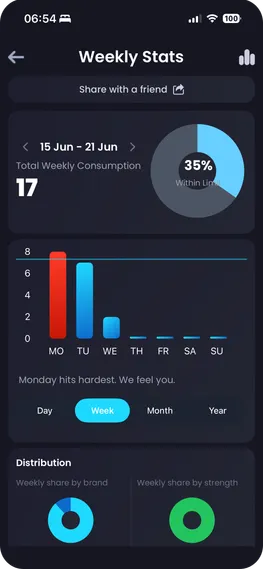
Breezer logs each pouch with one tap and shows the daily and weekly pattern, including the part most people underestimate: how much of it clusters around training and matches. If the number is higher than you expected, the snus tracker is where you set a daily limit; if you would rather stop altogether, Quit Mode covers the withdrawal timeline and what to expect in the first ten days.
Worth knowing before you compare brands: the strength printed on the can often is not the dose. That is covered in how strong a nicotine pouch really is. And if the reason you are reading this is the mouth rather than the training, what nicotine pouches do to your gums goes through the evidence.
Source: Professional Footballers’ Association and Loughborough University. A cross-sectional latent class analysis of self-reported snus use in men’s and women’s professional football in England. Journal of Science and Medicine in Sport, 2025.
Frequently asked questions
Is nicotine banned in sport?
No. Nicotine is not on the WADA Prohibited List. It sits on the Monitoring Program, where WADA tracks in-competition use as a stimulant to see whether misuse patterns emerge. Using it is not an anti-doping violation and carries no sanction.
Do nicotine pouches improve athletic performance?
The evidence says mostly no. Across studies of strength, endurance and high-intensity exercise, the large majority found no change in performance. A minority found small positive effects, and at least one found a negative effect.
Why do so many athletes use snus then?
Players report focus and relaxation after training rather than performance gains. The PFA and Loughborough study found roughly one in five professional footballers in England use it, and that a majority of those users showed signs of nicotine dependence.
Does nicotine affect recovery and sleep?
Nicotine is a stimulant, and disrupted sleep is one of the most commonly reported effects both during use and during withdrawal. Since sleep is where most physical adaptation happens, this is the part with the clearest downside for anyone training seriously.
Is it worth using pouches before a match or session?
There is no good evidence of a performance benefit to build a routine on, and a well-documented dependence risk. If you already use them, the more useful question is how many per day, not when.
Try Breezer for free
Download Breezer and start tracking in under a minute.